
The darkest achievement of political communication is not making people believe your lies. It is making them love your power so much that they no longer want to know the truth.
Although I was born in 1970, I remember that until the mid-1980s, in villages around Komotini — including Strymi and Pelagia, where I had relatives — there was a peculiar Greek habit. Portraits of King Constantine, Frederica, Sophia and the whole royal family hung on the walls of homes and cafés. Some even kept them on the household shrine, beside the Virgin Mary. Good Lord! The monarchy had ended in 1974, yet these people continued to venerate photographs of a dynasty with Danish roots that had left political wreckage, divisions and constitutional deviations behind. They were not rich or aristocratic; they did not own a square metre at Tatoi. They were farmers, workers, people who counted their bread. And yet the blue-bloods had managed to live in their homes like sacred family heirlooms. At the time, it simply seemed outrageous to me. Especially after my grandfather Christoforos’s stories about the monarchy’s antics, and my grandmother Nitsa’s panic when she caught me singing ‘Yanka dances, Anna Maria’ — terrified the neighbourhood gendarme might hear me and come to take my grandfather in for questioning yet again. Today I know I was looking straight at one of the darkest achievements of political communication in Greek history.
Real political power is not completed when you control the institutions. It is completed when you manage to settle inside the mind of the person you rule: when they stop judging you and start defending you; when questioning you becomes a personal insult, your failure a national misfortune and exposing your responsibility an act of betrayal. This is called the leader’s identification with collective identity. It is the point where political communication stops merely shaping opinions and begins organising the very perception of reality. The king no longer needs to prove that he serves the country. He has already persuaded part of society that **he is the country**. That is why dynasties can survive in people’s consciousness far longer than they survive on thrones. The state can dethrone them. But nobody easily takes them down from the household shrine.
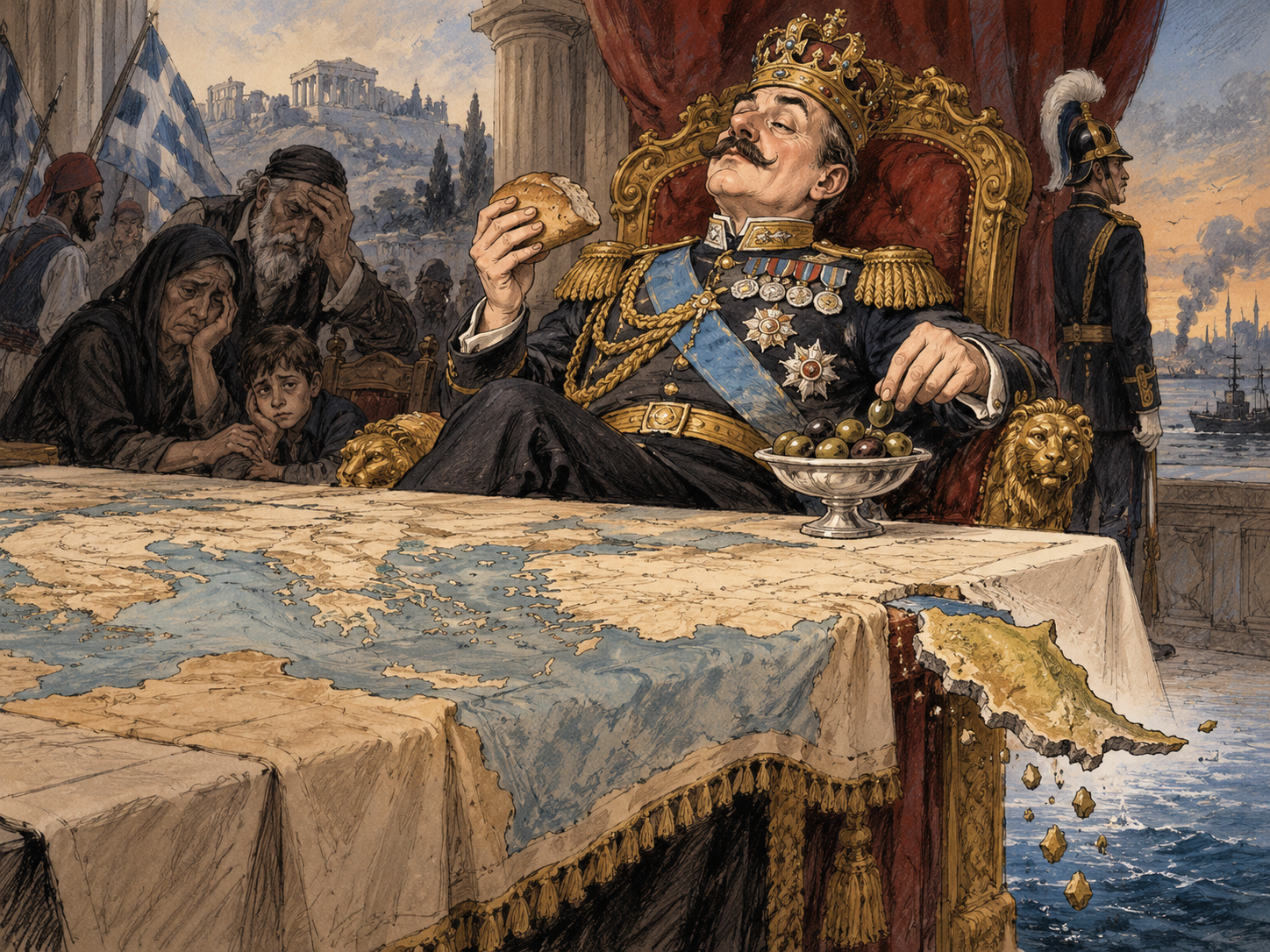
The occasion that made me think again about those frames was 17 October. On that day in 1915, Great Britain offered Cyprus to Greece in exchange for immediate military support for Serbia in the First World War. Prime Minister Alexandros Zaimis asked for time to consult King Constantine I, and on 21 October the government rejected the proposal. There were real military risks. Greece had no guarantee of success. But there was also a unique diplomatic possibility, which the palace’s conflict with Venizelos prevented from being considered outside the calculations of the National Schism. The offer was withdrawn. Greece eventually entered the war in 1917, without Cyprus. We do not know whether accepting would have changed the island’s history for good. We do know the opportunity was lost. The essential political question is how a leader’s image can come to matter more than an assessment of his decisions.
The answer lies in a slogan I still consider a monument to political manipulation: ‘Bread, olives and King Kotsos.’ It was associated with the royalist mobilisation of 1920, not with the decision of 1915, but it chillingly compresses the mindset cultivated by the National Schism. Let us take it apart as we might dissect a highly successful political campaign today. Bread means basic survival. The olive works twice over: as a popular symbol of frugality and as the emblem of the United Opposition of the time. And Kotsos? Here lies the political distortion. The monarch loses his title and gains intimacy. He is no longer King Constantine. He is our Kotsos. One of us. In three words, power becomes family, party identity becomes emotion, and poverty is presented as an acceptable price for loyalty. **The slogan promises the people nothing. It asks the people to ask for nothing.** That is its masterpiece. A political communications analyst does not see merely a catchy rhyme here. They see the complete reversal of the relationship between ruler and ruled.
Normally, a leader must prove what he offers citizens. Here the citizen is asked to prove how much they can endure going without for the leader. Bread and olives become medals of submission. Hardship acquires moral grandeur. And power enjoys a privilege greater than any constitutional authority: emotional immunity. You do not need to silence someone if you have convinced them that their protest will hurt the person they love. You do not need to erase failures if you can blame them on the leader’s enemies. The reactions in Greece during the National Schism did not, of course, disappear; society clashed violently. But for a significant part of it, faith in the monarch could work more powerfully than accountability. The tragic part is that you do not even need to organise a conspiracy to achieve this. You only need to construct a leader whose followers feel obliged to protect him from reality.
That is exactly what I saw on the walls of Thrace decades later. Not merely photographs of the last king, Constantine II, and his relatives, but the legacy of a political machine that had turned a dynasty into an object of personal devotion. I am not interested in the Glücksburgs’ Danish blood. Being anti-Greek is not a matter of ancestry. It is placing one person’s power above the country’s interests; cultivating the belief that patriotism means loyalty to the throne rather than demanding accountability; leaving a people to debate who should wear the crown while history presents them with opportunities that will not return.
**Bread, olives and King Kotsos, then. Cyprus did not come. The war did. The Schism remained. And Kotsos returned to the throne.**
Years later, in the homes of people who had nothing, his descendants still watched from the wall. Sometimes beside the Virgin Mary. Because power’s greatest achievement is not making you kneel.
**It is making you believe you kneel out of love.**